


Dating someone with kids means getting to know a partner whose responsibilities already include a child. A workable relationship needs room for adult companionship, dependable parenting, clear boundaries, and realistic schedules. You are not expected to become an instant parent, and a child’s attention or affection should never be treated as proof that the romance is progressing.
For adults exploring Ukrainian or international dating, there may also be distance, different languages, and complicated calendars to consider. Those circumstances are reasons to ask thoughtful questions. They do not tell you what a particular woman wants or what role she hopes a partner will play.
The following nine questions help you discuss the practical side of dating a parent without turning early conversations into an interrogation. Some belong at the beginning; others make sense only when a relationship has become established.
What should you understand before dating a parent?
Start by separating three relationships: your romantic relationship with the parent, the parent’s relationship with the child, and any relationship you may eventually develop with the child. They have different needs and may develop at different speeds.
You can be interested in a woman while knowing very little about her child at first. Respecting that privacy is different from being excluded from the adult relationship. The useful question is whether you and the parent can make understandable agreements about your own time together.
Children also differ in age, routines, personalities, and circumstances. A parent of a toddler, a teenager, or an independent adult may face quite different practical considerations. Ask about the relevant responsibilities without requesting details the parent prefers to keep private.
If you are returning to relationships after your own marriage ended, our guide to Ukrainian dating after divorce offers a broader starting point. Being ready for a new romance and being ready to date a parent are related questions, but they are not identical.
1. Am I comfortable with a relationship that includes parenting responsibilities?
Ask this privately before asking someone else to change their life for you. A parent may need to arrange childcare, change a plan when a child is unwell, or protect time that is not available for dating.
That does not mean your needs stop mattering. It means you need an arrangement that recognizes both the child’s existing needs and the adult relationship you are considering.
Think about actual situations. Would an interrupted call frustrate you beyond what you could discuss calmly? Do you need spontaneous travel that the other person cannot offer? Are you genuinely open to family life, or hoping parenthood will become a small detail once she knows you?
You are allowed to decide that dating a parent is not right for you. Recognizing that early is more considerate than continuing while resenting a responsibility that is not going away.
2. What kind of relationship are we each looking for?
Parenthood does not establish someone’s romantic goals. A parent may want companionship, a committed relationship, marriage eventually, or time to explore dating without deciding too much at once.
Start with the adult relationship rather than a proposed family role:
“I would like a steady relationship if we are compatible. What are you hoping to find, and what pace feels comfortable to you?”
Avoid saying that you are ready to become a father figure before you understand the person’s circumstances. That promise can create expectations you have not considered and that nobody asked you to make.
For more context about discussing goals without relying on assumptions, see our article on communication and expectations when dating a Ukrainian woman. Ask about her particular life rather than expecting nationality to predict her family preferences.
3. What time can we realistically make for dating?
Talk about a workable routine, including how you handle changes. A calendar that looks busy may still contain reliable time for a relationship. A promise of unlimited availability may be much less useful.
Try questions such as:
- Which times are usually comfortable for a longer conversation?
- How much notice helps when planning a date?
- If a family responsibility interrupts our plans, how would you prefer to reschedule?
- What amount of messaging feels enjoyable rather than demanding?
Offer your own constraints, too. If you are in the United States and she is elsewhere, identify overlapping hours without expecting someone to sacrifice sleep or family routines.
There is a difference between flexibility and endless uncertainty. A changed plan followed by a suggested alternative shows something different from a repeated pattern where neither person can identify time to connect. Discuss the pattern without framing the child as your competition.
4. What information about the child should remain private?
Ask the parent what they are comfortable sharing, and follow that lead. You do not need a child’s full name, school, address, photograph, or routine to begin an adult relationship.
Good early questions focus on relevant context: “Does your parenting schedule make weekday calls difficult?” is more proportionate than requesting a detailed account of where the child will be every evening.
Do not forward photographs, record calls involving a child, or share family details with others without permission. If a child unexpectedly appears during a video conversation, keep the exchange ordinary and let the parent decide how to handle it.
Your own privacy remains relevant as well. A relationship should not require personal passwords or access to private accounts. Clear information boundaries help both adults understand what is appropriate at their current stage.
5. When, if ever, would meeting the child make sense?
Discuss an introduction only when the adult relationship is sufficiently established to make it relevant. The parent needs to consider the child, and both adults should be comfortable with the plan.
Oklahoma State University Extension’s guidance on dating when you have children recommends preparing children for new introductions and protecting established family time. Its advice emphasizes balancing an adult relationship with children’s needs rather than treating the new relationship as a replacement for existing family routines.
A first introduction should not carry the task of proving that everyone will become a family. Avoid extravagant gifts, major promises, or asking the child to keep the meeting a secret.
In an international relationship, an expensive trip can create pressure to combine several milestones. Resist treating travel costs as a reason to rush an introduction. Your first in-person meeting with the parent and a later meeting with the child can be separate decisions.
6. What role would be appropriate if the relationship became serious?
Being kind and interested does not automatically give a new partner a parenting role. Discuss expectations gradually and specifically rather than assuming what “being part of the family” means.
Possible topics include attending an outing, helping with an agreed practical task, or remaining outside decisions about discipline and schooling. Do not make promises to the child that you and the parent have not discussed.
If the relationship progresses, ask: “What would be helpful from me, and what would you prefer to handle yourself?” Explain what you can realistically offer. It is better to state a limit clearly than to offer extensive help you later resent.
There is no need to compete with another parent or rewrite the family’s history. A respectful role develops through agreements and ordinary interactions, not through a declaration that you will replace someone.
7. How will we handle co-parenting boundaries?
Focus on how existing responsibilities affect your relationship, while recognizing that some family information belongs to the parent and child. Where another parent is involved, necessary communication may continue independently of the romance.
You can ask how scheduling works without requesting private messages, taking sides in old conflicts, or expecting the other adult to disappear from family life.
A useful question is, “Are there scheduling or communication boundaries I should understand so I do not make assumptions?” A less useful approach is demanding a detailed explanation every time the co-parent contacts her.
You can also identify what makes the adult relationship workable for you. If conflict repeatedly disrupts your time together, discuss its practical effects. You do not need to diagnose the other parent’s intentions or decide who was right in a previous relationship.
8. What practical limits matter in an international relationship?
Distance can affect call times, visits, spending, and any future discussion about living in the same place. Parenthood adds responsibilities that cannot be resolved by enthusiasm alone.
Keep early conversations proportionate. You can discuss whether international dating is realistic without trying to plan a family’s relocation. Do not assume that a parent and child are free, able, or willing to move.
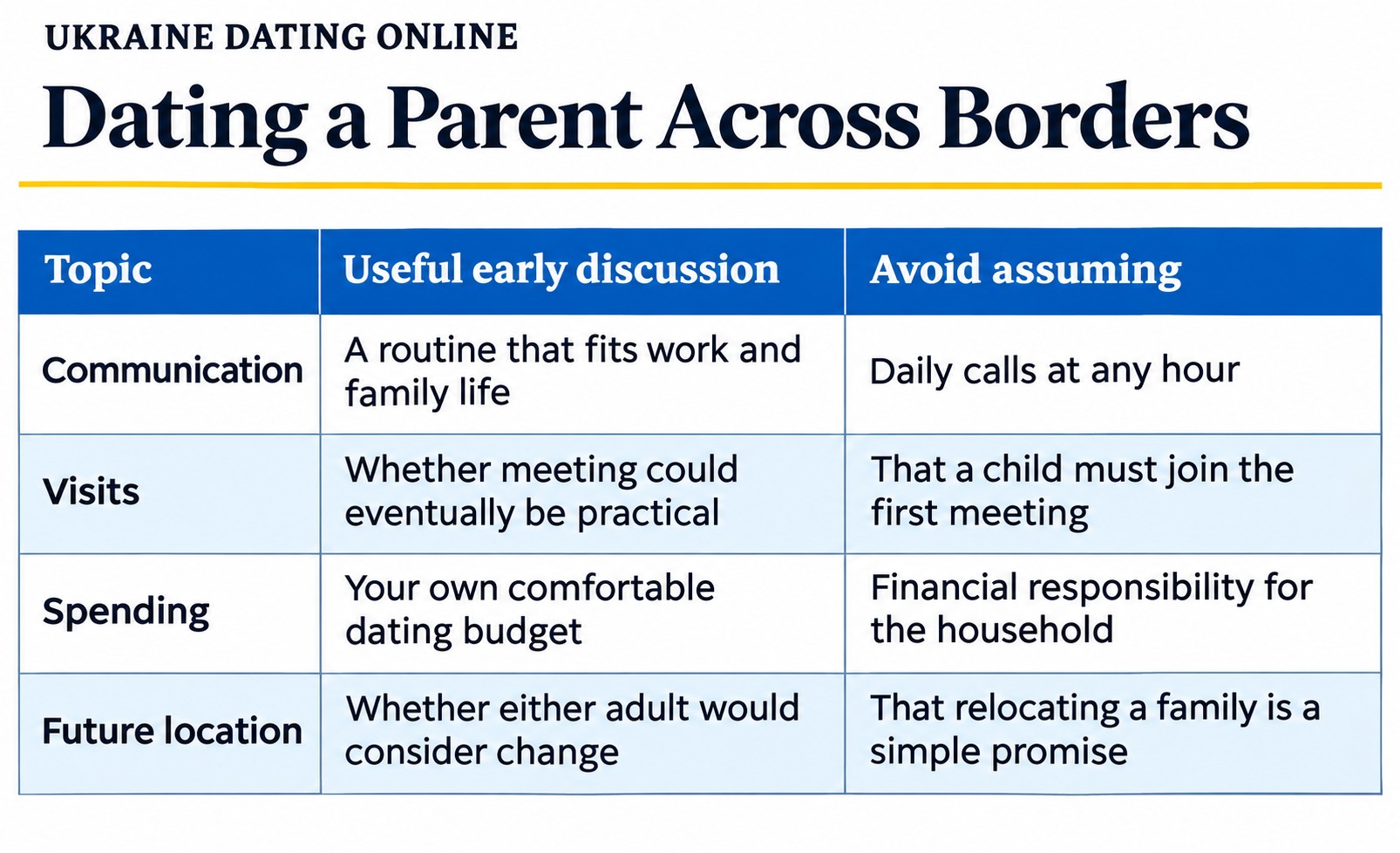
If concrete travel or relocation plans develop, obtain current information and appropriate professional guidance for those specific circumstances. An early dating conversation cannot settle family or immigration arrangements.
Our guide to Ukrainian dating after 40 in the U.S. discusses the wider question of fitting a relationship into an established adult life.
9. Do our actions show room for both the family and the relationship?
Look for realistic plans, mutual interest, respect for privacy, and an ability to discuss disappointment without blame. A parent should not need to neglect a child to prove romantic interest, and you should not need to ignore all your own needs to demonstrate understanding.
Some encouraging signs are simple: a missed call is acknowledged, another time is suggested, and both people can describe what is working. A boundary can be stated without turning into a test of affection.
Repeated pressure, secrecy involving a child, or promises neither adult can support deserve a pause. If the fit is wrong, you can step back respectfully without criticizing someone for being a parent.
It also helps to consider ordinary companionship, not just future family roles. Our article on building a relationship around friendship and companionship offers useful questions about whether you enjoy each other’s daily company.
How can you discuss these questions naturally?
Start with one topic that affects your current stage, explain why you are asking, and share your own answer. Leave more involved questions until they are relevant.
For example: “I enjoy our conversations and would like to plan them better. What times usually fit your week?” That is a practical invitation. Asking about a possible future parenting role before you have built an adult relationship is a different conversation.
If you would like broader conversation prompts, this DWP portfolio guide offers questions for getting to know a Ukrainian woman. Select questions that fit the individual and your stage rather than working through a checklist.
On any service, including Dream Singles, an online profile is an introduction. It does not settle compatibility, family expectations, or the pace of the relationship.
Frequently asked questions about dating someone with kids
Is dating someone with kids harder?
It can involve additional scheduling and family considerations, but experiences vary. The more useful question is whether the actual responsibilities and relationship expectations fit what both adults can offer.
Should I expect to come second to the child?
A child’s needs and an adult partner’s needs are different. Rather than ranking people, discuss whether there is consistent, realistic room for your relationship alongside parenting responsibilities.
How soon should I meet the children?
There is no single timetable for every family. Discuss the seriousness of the adult relationship, the child’s circumstances, and everyone’s comfort. An introduction should not be used to accelerate commitment.
What if I have never had children?
You can still ask respectful questions and decide whether you are comfortable dating a parent. Be honest about your experience and avoid promising a role before understanding what it involves.
Should I buy gifts for the child?
Ask the parent first. Gifts should not be used to win affection, bypass an introduction boundary, or imply a commitment that the adults have not agreed on.
Can I decide this is not right for me?
Yes. You can appreciate someone while recognizing that the relationship does not fit your circumstances. Explain that honestly and respectfully rather than asking the parent to minimize their responsibilities.
Start with a realistic conversation
Choose the question that matters at your current stage, listen to the answer, and consider whether your lives can make room for each other. Dating a parent works best as a relationship between two informed adults, with respect for the child and without promises made ahead of understanding.