


Dating with intention means making dating choices that reflect the relationship you actually want, then checking whether your actions and the other person’s actions support that goal. It involves clear preferences, honest conversations, and a willingness to step back when the fit is wrong. It does not require rushing toward exclusivity or deciding someone’s future after a few messages.
For men over 40 exploring Ukrainian or international dating, intention also includes practical questions. Do you have time for conversations across time zones? Are you open to dating a parent? What kind of companionship fits your current life? These details matter alongside attraction.
This guide offers seven essential steps, sample wording, and a simple worksheet you can use before starting another conversation. The purpose is to help you make considered choices while leaving room for curiosity and a connection to develop naturally.
What does dating with intention look like in practice?
Intentional dating combines a clear direction with an open mind. You know the kind of relationship you are available for, explain that honestly, and pay attention to compatibility without expecting an early connection to follow a fixed timetable.
For example, you might want a committed relationship eventually while still needing time to decide whether a particular person is right for you. Those positions are compatible. Being serious about your search does not mean making serious promises to everyone you meet.
It also helps to distinguish a goal from a demand. “I would like a relationship that could lead to marriage” describes your direction. “You need to decide whether you will marry me this month” puts pressure on someone whose feelings may still be developing.
If you are still comparing platforms, our guide to choosing a Ukrainian dating site for your relationship goals explains the service-level questions to ask. The steps below focus on the choices you make once you begin meeting people.
1. Describe the relationship you can offer now
Start with your present circumstances rather than an ideal future version of yourself. A useful intention includes both what you want and what you can realistically contribute.
Write down your available time, location, family responsibilities, and preferred pace. If you enjoy the idea of international dating but cannot currently travel or manage regular conversations, acknowledge that before presenting distance as easy.
Compare these introductions:
- Vague: “I am looking for the right woman.”
- Clearer: “I would like a steady relationship and enjoy getting to know someone gradually. I can make time for a couple of planned conversations each week.”
- Clearer for international dating: “I am open to a relationship across countries, but I would want us to discuss schedules and practical expectations as we get closer.”
You do not need a perfect schedule. You do need to avoid promising attention, travel, or availability that your current life cannot support. If a major change is uncertain, describe it as a possibility rather than a settled plan.
2. Separate values, preferences, and practical limits
A shorter, clearer set of priorities is more useful than a long checklist. Separate the qualities that affect a relationship’s foundation from preferences you could comfortably reconsider.
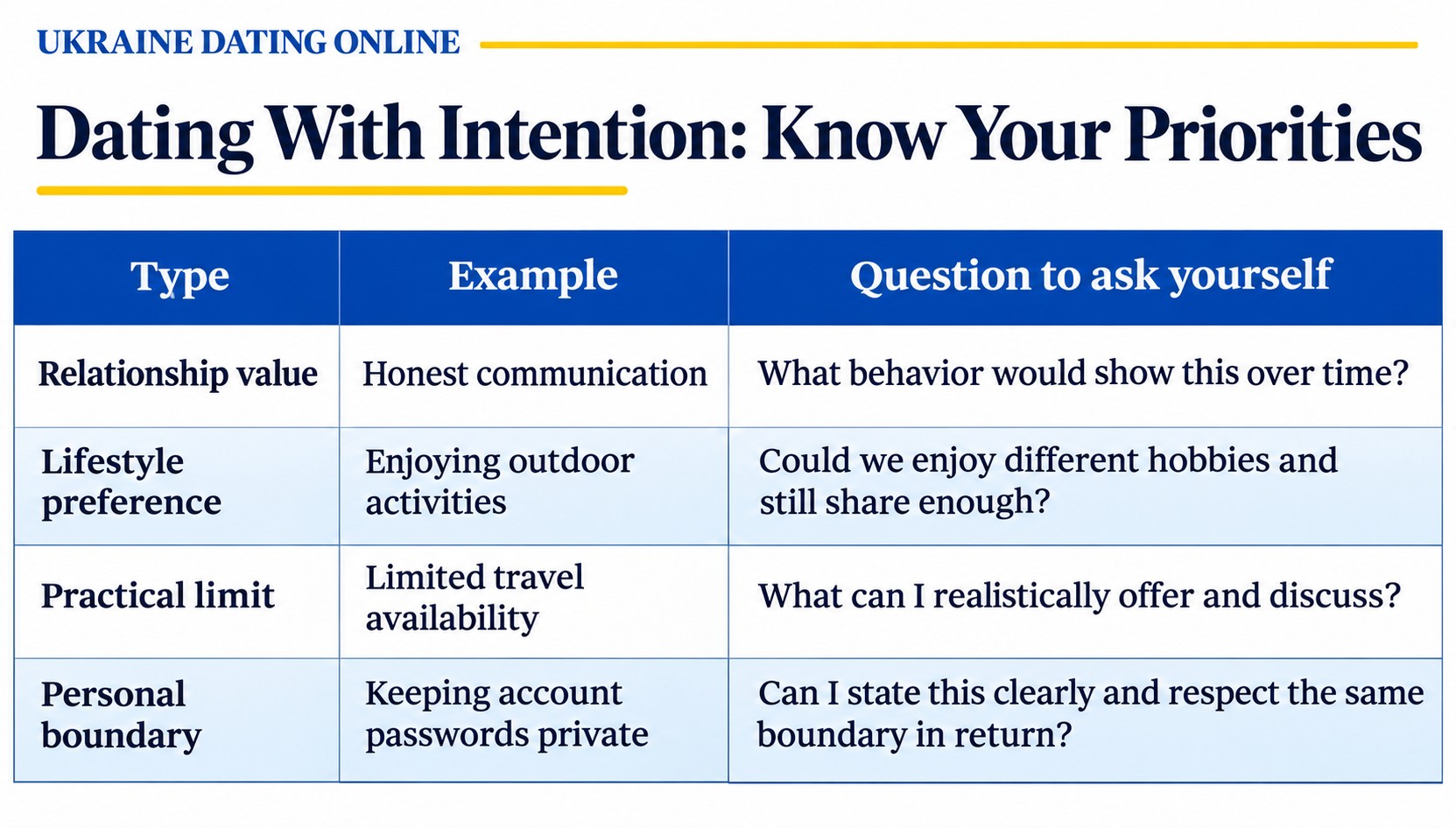
A value such as kindness needs more definition than a label. You might look for whether someone listens, respects a change of plans, or responds considerately when you disagree.
Preferences also deserve honesty. You can care about attraction, shared interests, or a compatible routine without presenting every preference as essential. Ask whether the item affects daily life or simply matches a picture you had in mind.
When meeting Ukrainian women, do not use nationality as a shortcut for your values. Ask about the individual. Our guide to communication and expectations when dating a Ukrainian woman explains how to have those conversations without relying on cultural assumptions.
3. Make your profile and messages match your intention
If your profile describes a serious relationship but your conversations stay entirely focused on appearance, the message becomes inconsistent. Use your introduction to show what everyday companionship with you might involve.
A profile sentence could read:
“I enjoy weekend walks, cooking for friends, and conversations that continue beyond small talk. I would like a committed relationship, with enough time to learn whether we are a good fit.”
Change every detail to something true for you. A clear intention does not compensate for inaccurate photographs, an incorrect relationship status, or a bio written around interests you do not have.
Messages can be warm and light without abandoning your direction. Ask about something the person has shared, offer a little context from your life, and leave room for an answer. You can enjoy a conversation before discussing every major relationship topic.
If you are returning after a marriage has ended, our article on approaching Ukrainian dating after divorce covers that wider transition. You do not need to turn every new introduction into an account of your previous relationship.
4. Ask questions that reveal compatibility
Choose questions that help you understand how someone lives, communicates, and sees a relationship. Spread them across conversations and answer them yourself.
- “What would you like a relationship to add to your life?”
- “What does a good ordinary weekend look like for you?”
- “How much time do you enjoy spending together and independently?”
- “How do work or family responsibilities affect your availability?”
- “If a relationship became serious, what would distance mean for you?”
- “What do you prefer to discuss before becoming exclusive?”
Notice where you need clarification. “Family is important” can mean regular calls with relatives, raising children, caring for an older parent, or several other things. Ask what it means in that person’s life instead of filling in the details yourself.
A conversation is also allowed to remain incomplete. If someone is unsure about relocation or future children, an honest uncertainty tells you more than a quick answer offered to please you. Decide whether that uncertainty fits your needs without demanding a different response.
5. Distinguish boundaries from unspoken expectations
A boundary describes what you are comfortable participating in. An expectation describes what you think should happen. Making both explicit reduces the chance that you are judging someone against an agreement you never made.
The relationship education organization love is respect explains this distinction in its resource on boundaries and expectations. Its guidance emphasizes discussing expectations rather than assuming a partner already understands them.
For example, wanting to hear from someone daily is a preference to discuss. It does not establish an obligation before you have talked about your schedules. Keeping personal passwords private is a boundary that does not need to be traded away to demonstrate affection.
Try specific wording: “I enjoy regular contact, but I cannot answer during work. Would planned evening conversations suit you?” This gives the other person enough information to consider an arrangement, rather than asking them to guess what counts as sufficient effort.
Compatibility includes how each person responds to a reasonable limit. Someone can be disappointed and still respond respectfully. Repeated pressure after a clear refusal deserves attention.
6. Evaluate patterns rather than isolated gestures
Look at what happens over a reasonable period: whether interest is reciprocal, whether plans are followed through, and whether conversations become clearer. Avoid treating one romantic message or one delayed reply as a complete verdict.
A simple reflection after a few conversations can help:
- Am I interested in this particular person or mainly relieved to receive attention?
- Do we both ask questions and contribute to the conversation?
- Are important expectations becoming clearer?
- Can we suggest changes without someone becoming dismissive?
- Are we learning about real routines as well as future dreams?
You are not assigning someone a score. You are noticing whether the connection fits what you said you wanted. If you feel confused, ask about the specific behavior before assuming a motive.
Practical safety remains relevant even when the words sound serious. The FTC’s romance-scam guidance warns against sending money to an online romantic interest. A claim of commitment should not override a financial boundary.
7. Choose a next step instead of drifting
After enough interaction to form a view, decide what you would like to do next. That may be another conversation, a discussion about exclusivity, a pause, or a respectful ending.
Use language that matches your actual level of certainty:
- Continue: “I am enjoying this and would like to make more time to talk. How are you feeling?”
- Clarify: “We seem to want different amounts of contact. Can we discuss what would work for each of us?”
- Step back: “I have enjoyed getting to know you, but I do not think our relationship goals fit. I do not want to imply otherwise.”
Do not imply exclusivity through vague promises if you have not agreed to it. Equally, do not continue expressing romantic interest simply because ending an exchange feels awkward.
For a broader view of early-stage international communication, see our guide to the first month of international dating. There is no universal deadline for the next step; the useful question is whether both people understand it.
A short intentional dating worksheet
Complete these sentences privately before your next conversation. Revisit them when your circumstances or understanding changes.
- I am looking for a relationship that includes…
- The time and attention I can offer now are…
- The values I need to see in behavior are…
- The preferences I can remain flexible about are…
- My practical limits around distance and spending are…
- The question I need to ask rather than assume is…
- My next honest step with this connection is…
If a platform is part of your plan, compare its features and terms against your needs. Dream Singles Review offers related background on that service, while Dream Singles provides its current account information directly. A service can facilitate introductions; the relationship decisions still belong to the two people involved.
Frequently asked questions about dating with intention
Does dating with intention mean looking for marriage?
It can, but it does not have to. The key is being clear about the relationship you want and available to build, whether that is companionship, a committed partnership, or eventual marriage.
How early should I explain my intentions?
State your general direction early enough to avoid misleading someone. More detailed discussions about exclusivity, family, or relocation can develop as you get to know each other.
Can intentional dating still feel spontaneous?
Yes. Clarity about your direction leaves plenty of room for humor, attraction, shared activities, and surprises. You do not need to make each conversation a relationship review.
What if the other person is unsure what they want?
Take the uncertainty seriously and decide whether you are comfortable continuing. You can ask for clarification without treating someone as a project whose answer you need to change.
Should I stop talking to everyone else immediately?
That depends on your preferences and agreements. Intentional dating does not automatically establish exclusivity. Discuss it explicitly before assuming you share the same understanding.
How is this different in international dating?
The core approach is the same. International dating adds practical questions about language, communication schedules, distance, and possible future meetings. Discuss these with the individual rather than making assumptions from nationality.
Make one choice that matches your intention
Start by writing an honest statement of what you want and what you can offer now. Then choose one action that reflects it: revise your profile, ask a useful question, or clarify an uncertain connection. Direction becomes meaningful when your everyday choices support it.