


The best long distance relationship games are easy to explain, comfortable for both people, and possible with the communication tools you already use. Try a short guessing game, a drawing challenge, or a shared story before committing to a complicated app or an entire evening online.
Games can give a conversation a relaxed focus, especially when you are still learning about each other. They do not prove compatibility or replace an honest discussion about the relationship. Choose something you both want to try and make it easy to stop or change the plan.
These 15 ideas include clear rules, original prompts, and adaptations for text, voice, video, different language levels, and limited schedule overlap. No specialist gaming knowledge is needed. Any communication or platform charges are separate from the activities themselves.
Which long distance relationship games should you try first?
Start with a game that matches your available time, preferred format, and shared language. For a new connection, choose a light topic with simple rules. For an established relationship, add personal memories or collaborative challenges if you both enjoy them.
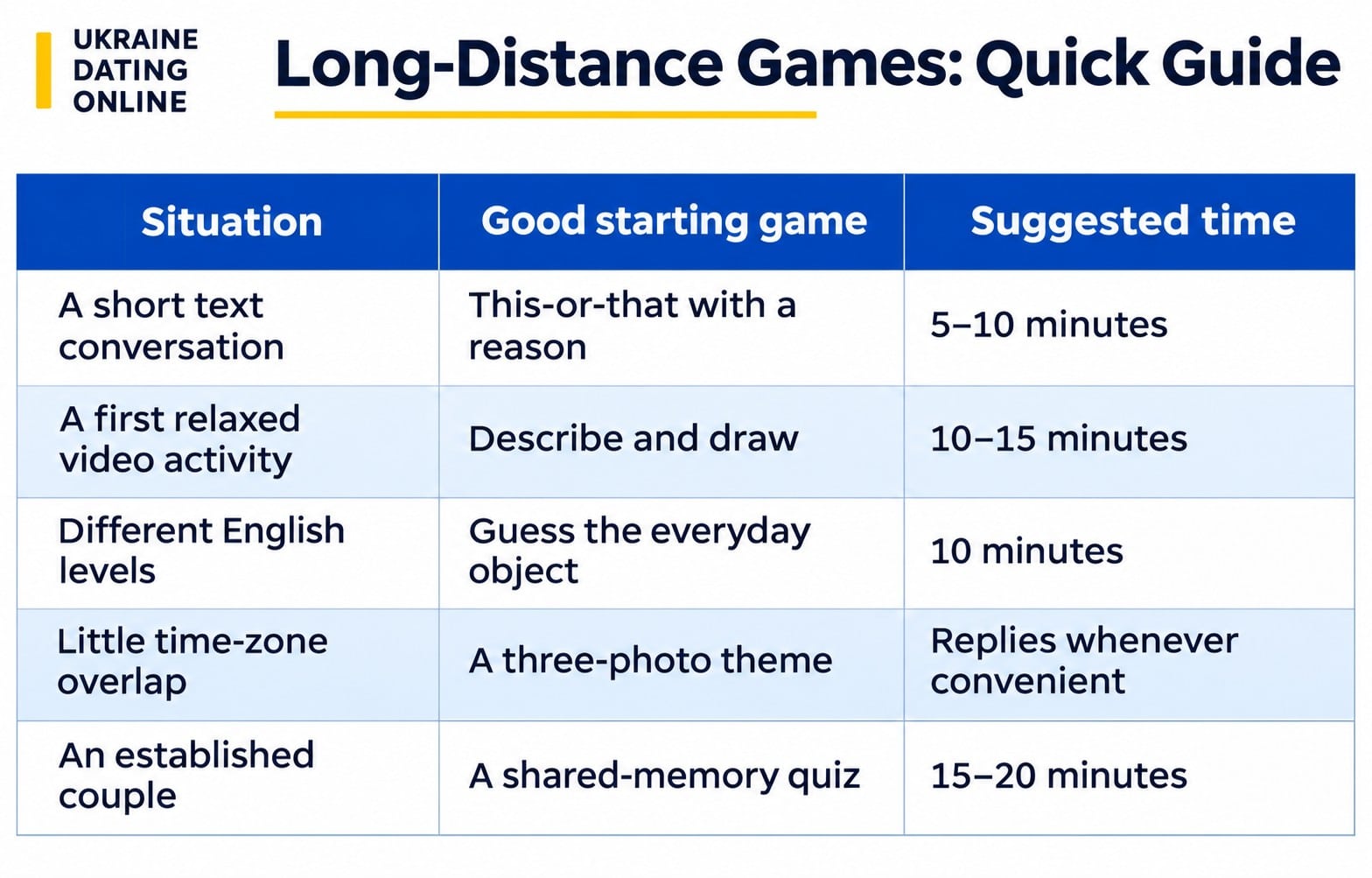
The times above are planning suggestions, not rules. Ask whether your partner has the energy for an activity. Someone finishing a demanding day may prefer a straightforward conversation.
If you are exploring communication tools, our overview of the Dream Singles chat interface explains that platform’s conversation features. The games here are conversation activities; this article is not claiming that the platform includes a separate gaming service.
Easy games to play over text or voice
1. This-or-that, with a reason
Offer two ordinary choices and ask your partner to choose one and explain why. Take turns so both people ask and answer. Begin with “A mountain walk or a museum afternoon?” or “Cooking together or trying a new restaurant?”
The explanation is more useful than the choice. If your partner chooses a museum, ask what kind she enjoys. Skip choices about sex, money, or major commitments unless you already know those topics are welcome. Three rounds can be enough.
2. Guess the everyday object
Choose an object you can see and give three clues without naming it. Your partner can ask up to five yes-or-no questions before guessing. Then switch roles.
For example: “It fits in one hand, I use it every morning, and it is usually near the kitchen.” Choose familiar objects rather than items that require local knowledge. If language is a barrier, add a drawing or allow a choice between three answers.
3. Two facts and one fiction
Share three harmless statements about food, hobbies, or everyday experiences. Two are true; one is invented. Your partner guesses the invented statement, and you reveal it before the round ends.
Make the fictional part clearly bounded to the game. Do not use false claims about relationship status, children, employment, or other important personal information. Keep the stories light and let the answers open a conversation rather than keeping a running score.
4. Build a story one sentence at a time
Begin an imaginary story with one sentence, then alternate adding a sentence each. Agree on a gentle theme, such as a lost picnic basket or a train journey with an unexpected destination.
Keep the story short, perhaps eight turns each. You can decide together whether it ends happily, absurdly, or with a mystery for the next call. If someone is using a second language, prioritize the idea over correcting grammar.
5. Five clues to a favorite meal
Choose a dish you enjoy and describe its ingredients, texture, temperature, or a memory connected to it. Your partner tries to identify it. If the name is unfamiliar, revealing and explaining the dish still completes the round.
This can introduce personal traditions without expecting someone to represent a whole country. Ask whether the meal matters in her own family. Do not assume she cooks it or that it is typical of every Ukrainian household.
Video games that need only ordinary household items
6. Describe and draw
One person privately chooses a simple picture or object, then describes it while the other draws. Set a five-minute limit. Reveal the original and drawing together, then swap roles.
Use descriptions such as “a large circle with two small squares underneath.” The funny result is part of the activity. Choose an abstract sketch if everyday vocabulary is difficult, and avoid scoring drawing ability. Paper and a pencil are enough.
7. The five-object memory tray
Place five ordinary objects on a tray and show them briefly on camera. Cover the tray, then ask your partner which objects they remember. For the next round, remove one object and ask what changed.
Start with familiar items such as a spoon, a pen, a book, a cup, and a piece of fruit. Keep private documents and valuable items out of view. Increase the challenge only if both people enjoy it.
8. A tiny design challenge
Give yourselves five minutes to make a small arrangement using three ordinary objects. Choose a theme such as “a cozy evening” or “a place I would like to visit.” Reveal your creations and explain the choices.
You are not judging taste or spending money on supplies. A folded napkin, a mug, and a book can be enough. Keep the challenge at the table rather than searching through rooms or showing areas of your home you prefer to keep private.
9. Silent charades
Take turns acting out an everyday activity without speaking. Try making tea, walking a dog, or searching for misplaced glasses. Limit each round to a minute, then offer a clue if needed.
Choose actions that can be performed safely while seated or standing comfortably. There is no need for physical dares or embarrassing performances. This can be useful when you want a less language-heavy activity, but ask first whether your partner enjoys acting.
10. A friendly caption contest
Choose an ordinary photograph you took yourself, such as a pet’s expression or an unusually shaped vegetable. Each person writes a short caption, then reads it aloud. You can choose the funniest one together or skip choosing a winner.
Do not use photographs of strangers, children, private documents, or something your partner has not agreed to share. Keep the humor about the image rather than using it to mock each other.
Games for different time zones and delayed replies
11. A three-photo theme
Agree on a theme such as “something blue,” “a small comfort,” or “an interesting shape.” Each person sends up to three photographs over the next few days, with a sentence about their choices.
There is no race or obligation to reply immediately. Choose images that do not expose an address, workplace, school, or another person’s private information. If sending photographs is inconvenient, descriptions or simple drawings work too.
12. The imaginary afternoon budget
Invent a shared afternoon and set a pretend budget. Take turns suggesting an activity, a meal, and a quiet place to talk while keeping within the agreed limit. Explain what makes each choice appealing.
Use a hypothetical amount you both understand and clarify that no actual purchase or travel is being arranged. This is an imaginative way to discuss preferences, not a request for someone to pay for a future date.
13. The question relay
One person asks a light question, and both answer before the next question begins. Pass the turn back and forth over several days. Start with “Which ordinary task would you happily outsource?” or “What did you enjoy learning recently?”
Agree that either person can skip a question. For additional topics, the DWP portfolio guide to getting to know someone through thoughtful questions offers a broader starting point. Choose prompts that fit the individual, not assumptions about nationality.
Personal games for couples who know each other better
14. A shared-memory quiz
Each person writes three questions about enjoyable moments you both experienced: a funny exchange, a recipe you tried, or a song discussed on an earlier call. Take turns answering and explaining what you remember.
Do not treat an incorrect answer as a sign that someone does not care. Memory differs, and the point is revisiting the experience together. Keep private disagreements or unresolved relationship issues outside the quiz.
15. Guess the playlist story
Choose three songs associated with different stories from your life. Give your partner a hint about each memory and let them guess which song fits. Explain the actual connection after the guess.
You can exchange titles rather than share account access or stream music during a call. There is no requirement to enjoy the same genre. If music is not a shared interest, use books, films, or favorite places instead.
How can you make games work across languages?
Choose short instructions, explain unfamiliar words, and adapt the activity together. Visual clues, fewer rounds, and extra thinking time can be more useful than repeated corrections.
For example, turn an open-ended guessing game into a choice between three objects. Or take turns drawing instead of relying entirely on wordplay. The adaptation should make participation easier for both people, not cast one person as a teacher evaluating the other.
Our guide to dating without speaking Ukrainian offers broader communication suggestions. Ask which language and format the individual prefers rather than assuming that every Ukrainian woman has the same language background.
What boundaries make a game comfortable?
Agree that either person can pass, stop, or change the subject without needing to justify it. A game should not require private photographs, passwords, personal documents, money, or a declaration of commitment.
If you decide to use a separate gaming service, review its access requirements and charges directly before making an account or purchase. A simple conversation game does not require moving away from a communication service you are comfortable using.
For the relationship itself, keep room for ordinary conversation. Our article on common communication mistakes in long-distance relationships addresses patterns that a playful activity cannot solve on its own.
How do you plan a simple game date?
- Offer two possible games and let your partner help choose.
- Confirm the date and local time in both locations.
- Explain any materials needed, keeping preparation small.
- Start with one short round and check whether you both enjoy it.
- Leave a little time to talk afterward.
- Decide together whether to repeat it, try something else, or keep the next call unstructured.
If the internet connection fails, switch formats or reschedule. A technical interruption is not a useful measure of romantic interest. Our general long-distance relationship advice covers the wider habits that support communication across distance.

Frequently asked questions
What games can long-distance couples play without an app?
Try this-or-that, guessing an everyday object, a shared story, describe-and-draw, or a memory tray. These activities use conversation and ordinary items rather than specialist software.
What is a good game for a new online connection?
Choose a light activity with an easy opt-out, such as three rounds of this-or-that. Keep questions proportionate to how well you know each other and avoid demanding personal disclosures.
Can these games be played through text?
Many can. The question relay, shared story, meal guessing, and this-or-that work well in writing. Agree whether replies will be immediate or whenever each person has time.
Are the games free?
The activity ideas do not require buying a game. Your communication platform, internet service, or any separate software you choose may have charges, so check those independently.
What if my partner does not enjoy games?
Respect that preference. Offer another way to spend time together, such as a relaxed conversation or discussing something you both read. Participation should not be a test of enthusiasm for the relationship.
Will games make a long-distance relationship stronger?
They can provide an enjoyable shared activity, but they do not guarantee closeness or resolve incompatible expectations. Pay attention to whether both people enjoy the time together and communicate openly outside the game.
Choose a game you both want to play
Begin with a small invitation: “Would you like to try a ten-minute guessing game on our next call?” Let the other person suggest changes. The useful result is a comfortable shared experience, whether the game becomes a favorite or simply gives you something new to talk about.
Try 25 long distance date ideas for couples in different time zones, from virtual dinners and movie nights to games, travel planning and creative surprises. Learn more “here”.