


Relationship deal breakers are behaviors or incompatibilities that make a relationship unsuitable for you, even when attraction is strong. They may involve honesty, children, commitment, personal boundaries, or the practical ability to build a life together. A meaningful deal breaker describes something you cannot comfortably accept, rather than a rule the other person must follow to earn your approval.
Dating after 40 can make these decisions feel complicated. You may have a settled career, family responsibilities, or a previous relationship that changed what you need. When you meet someone you enjoy, it can be tempting to postpone an uncomfortable question and hope the answer eventually fits.
International dating adds questions about distance and future location. Those questions deserve attention without assuming that a Ukrainian woman shares particular values because of her nationality. The following checks help you decide what needs a conversation, what allows compromise, and what may mean the connection is not right.
Deal breaker, preference, or red flag?
A preference is something you would enjoy but could reasonably reconsider. A deal breaker is a limit or incompatibility you are not willing to live with. A red flag is a warning sign that deserves attention; it is not automatically a complete explanation of someone’s intentions.
These categories can overlap. Serious dishonesty may be both a warning sign and a reason to leave. Different plans about having children may be a deal breaker without either person behaving badly.
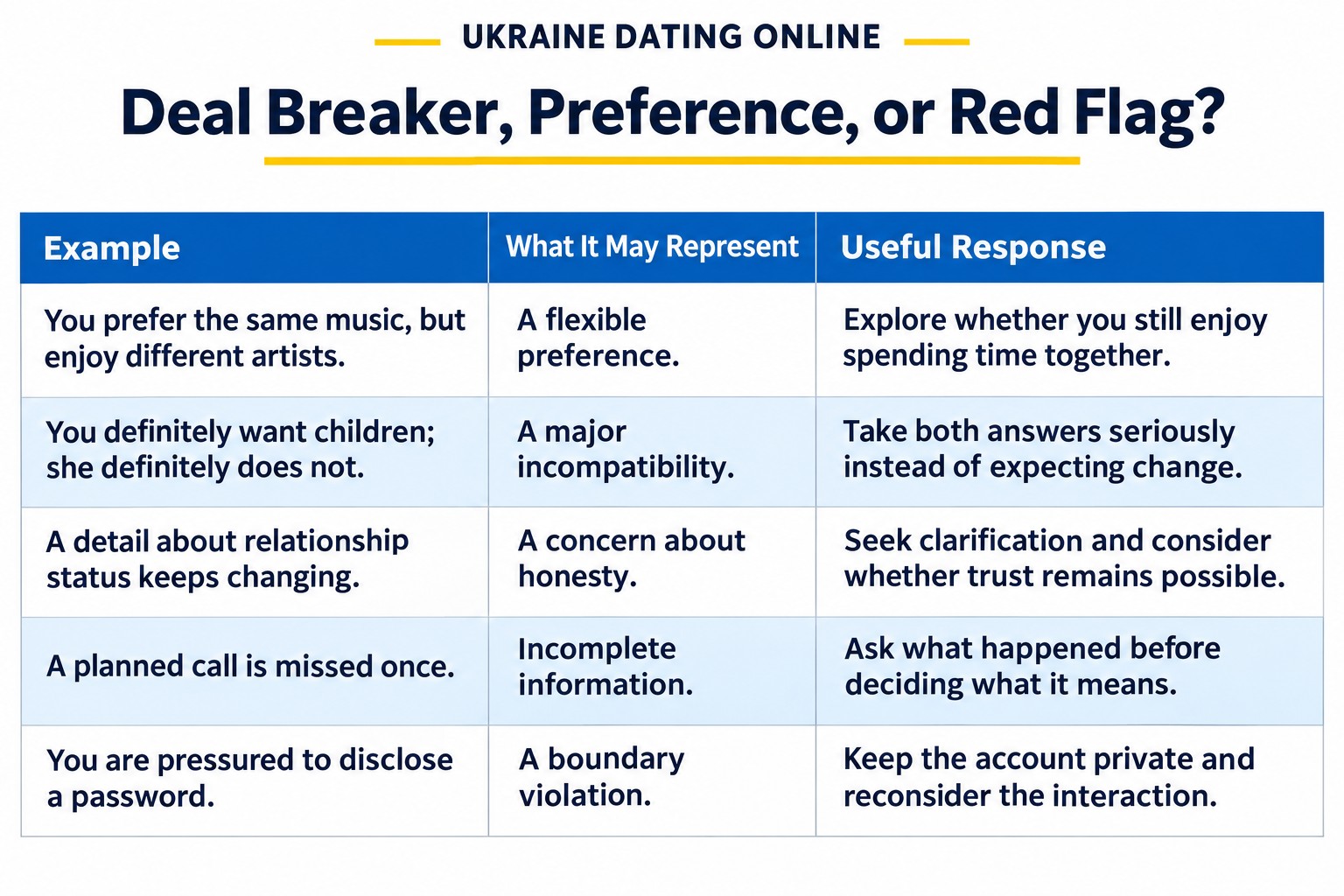
You do not need a universal list that applies to everyone. Start with your own circumstances. Our guide to dating with intention provides the broader framework; the checks below focus specifically on deciding whether an incompatibility is something you can accept.
9 essential relationship deal breaker checks after 40
1. Are your relationship goals fundamentally different?
One person may want eventual marriage while the other wants companionship without marriage. Both can be honest, considerate people and still want different relationships.
Ask: “If we became a good match, what kind of relationship would you hope to build?” Explain your answer without presenting a proposal. You are checking direction, not asking for a commitment to someone you barely know.
Decide whether the difference concerns timing or the destination itself. “I need more time to know you” differs from “I do not want marriage.” If marriage is essential to you, continuing on the assumption that you will change her mind is unfair to both of you.
2. Can you trust important information?
Some information directly affects your decision to date: relationship status, current circumstances, and whether significant promises are truthful. Privacy is different from misleading someone about those matters.
A person may prefer not to disclose an address or employer early on. That does not make them dishonest. A contradiction about whether they are already in a relationship raises a different question.
Be specific: “Earlier, I understood that you were single. Now you have mentioned a partner. Could you clarify your situation?” You are allowed to decide that the explanation does not restore your confidence. You do not need to investigate someone indefinitely before stepping back.
3. Do your plans about children fit?
After 40, this may mean wanting a first child, being certain you do not want more children, or deciding whether you are comfortable dating someone who already has them.
Discuss the future you actually want. Avoid offering a vague “maybe” simply because you worry that an honest answer will end the conversation. Equally, accept someone else’s uncertainty as uncertainty.
Existing children bring responsibilities that do not disappear when romance develops. If that is not a life you want, acknowledge the mismatch without treating the parent as less desirable. Our guide to dating someone with kids explores the practical questions in more depth.
4. Is living in the same place eventually realistic?
Enjoying conversations across countries is different from wanting an indefinitely long-distance relationship. Ask yourself which arrangement you could genuinely sustain.
If you cannot relocate because of family or work, say so. Ask whether the other person has comparable limits, without assuming she wants or is able to move. A Ukrainian woman may already live outside Ukraine or have strong reasons to remain where she is.
You do not need a moving date during early conversations. However, if both of you need a partner nearby eventually and neither can imagine changing location, attraction alone does not resolve the problem. Discuss whether the relationship you can realistically offer matches the one you each want.
5. Are your expectations about money compatible?
Different incomes are not automatically a deal breaker. The more useful question is whether your expectations about spending, independence, and responsibility can coexist.
You might be comfortable budgeting for occasional trips but unwilling to fund a lifestyle beyond your means. Say: “I enjoy planning things together, but I need dating expenses to stay within a budget.” Notice whether this leads to a practical discussion or pressure to prove affection through spending.
Requests for transfers from an online romantic interest require particular caution. The FTC’s romance-scam guidance advises against sending money or gifts to someone you have not met in person and warns about investment pitches. If you suspect a scam, stop communicating and report it to the platform. This concern applies regardless of nationality.
6. Can you disagree without losing respect?
Disagreement can reveal a mismatch in everyday expectations. Suppose you prefer planning a call while she prefers spontaneous contact. The question is whether you can discuss an arrangement that respects both schedules.
Compare “That time is difficult for me; could we try tomorrow?” with ridicule or demands that you abandon your other responsibilities. An inconvenient preference is different from contempt for your needs.
Ask yourself whether you feel able to explain a different view. You do not need a partner who agrees with every opinion. You may need someone who can remain considerate when agreement is impossible. Be prepared to offer that same consideration yourself.
7. Are your personal boundaries respected?
A relationship should leave room for a clear refusal. Consider what happens when you decline a request, prefer a slower pace, or keep something private.
The relationship education resource love is respect explains personal boundaries as limits around comfort and treatment, including physical, emotional, and digital matters. Your limits do not need to match another person’s, but each person should be free to express them.
For example: “I am comfortable continuing to talk here, but I am not ready to share private photographs.” You do not need to provide something intimate to keep a connection. If someone keeps pressing after you have clearly declined, take that behavior seriously. You can end the interaction rather than continue negotiating.
8. Do your everyday lives leave room for each other?
Compatibility also involves ordinary routines. One person may want frequent travel and late nights; another may prioritize a predictable schedule and caring for relatives.
Different hobbies can add interest to a relationship. A problem arises when the actual arrangement would leave one or both people persistently unhappy. Ask what an ordinary week together would look like, rather than imagining only holidays.
Shared activities can help you learn what you enjoy together. These long-distance date ideas offer options for time apart. Choose activities you both want to try, then notice whether companionship feels comfortable without either person performing a different lifestyle.
9. Are you accepting the person who exists now?
Imagine that the major facts you know remain the same. She does not change her view about children, you do not suddenly become able to relocate, and neither person adopts the other’s preferred lifestyle. Would you still choose the relationship?
This question separates openness from a private plan to change someone. People can grow, but a decision about compatibility should not depend on a transformation nobody has promised.
Apply the same standard to yourself. Do not promise a future version of your availability or finances just to preserve a promising connection. Our guide to communication and expectations when dating a Ukrainian woman offers context for explaining what you can actually bring to a relationship.
How to discuss a deal breaker without issuing an ultimatum
Introduce one topic when it becomes relevant. Explain your own position, ask an open question, and listen without trying to secure a preferred answer. A conversation about compatibility should provide information both people can use.
For example: “I have realized that I want to live with a partner eventually, but my family responsibilities mean I cannot move abroad. How does that fit with what you want?” That is clearer than asking whether she would “do anything for love.”
Check that you understood the response. Language differences can make words such as “serious,” “soon,” or “family” ambiguous. Ask for the practical meaning rather than filling in the gaps with hopes or fears.
Then decide whether you can accept the answer. If the topic involves coercion or you feel unsafe, you do not owe someone a further discussion or an in-person explanation before ending contact.
A simple way to sort your relationship non-negotiables
For each concern, write down the actual issue, why it matters, and what you still need to know. This prevents a vague feeling from becoming a sweeping judgment about the other person.
- Concern: We may have incompatible plans about children.
- My position: I do not want to raise more children.
- What I know: She has said she hopes to become a parent.
- What I need to clarify: Whether that is a firm life goal.
- My decision if it is firm: End the romantic connection respectfully.
Use the exercise to understand your own decision, not to score someone against a secret checklist. If a preference does not meaningfully affect the relationship you want, consider whether you could remain flexible about it.

Frequently asked questions
What are common relationship deal breakers?
Examples include incompatible plans about children or marriage, serious dishonesty, pressure around personal boundaries, and an unworkable future location. The important question is what the specific issue means for your relationship, rather than whether it appears on a popular list.
Are deal breakers the same as red flags?
No. A red flag signals a concern worth examining. A deal breaker is a reason you decide not to continue. Two people can have a deal-breaking incompatibility without either person being dishonest or unkind.
Can you have too many dating deal breakers?
It helps to separate essentials from an idealized picture of a partner. Ask whether each item protects something important in your life or simply describes what you imagined. You can reconsider preferences while keeping meaningful limits.
When should you discuss non-negotiables?
Raise matters that could fundamentally change your decision before making commitments that depend on them. You can state your relationship direction early and discuss more detailed practical questions as mutual interest develops.
How do you end things over an incompatibility?
If it feels safe, keep the explanation clear and respectful: “I have enjoyed knowing you, but our plans about children are different. I do not want to continue while hoping your answer changes.” Avoid offering romantic promises afterward that contradict your decision.
Choose a relationship you can honestly participate in
Relationship deal breakers help you recognize the kind of partnership you can sustain. Use them to make honest choices while allowing the other person the same freedom.
Before your next conversation, identify one important uncertainty and ask about it directly. A clear answer may bring you closer, or it may reveal that your lives need different things. Either outcome gives you a better basis for deciding what comes next.